
PyNutil#
A Python library for brain-wide quantification and spatial analysis of features in serial section images from the brain.
Installation, input formats and the core quantification workflow.
Run the same atlas-based analyses through the desktop interface.
3D visualisation, heatmaps and worked Python examples.
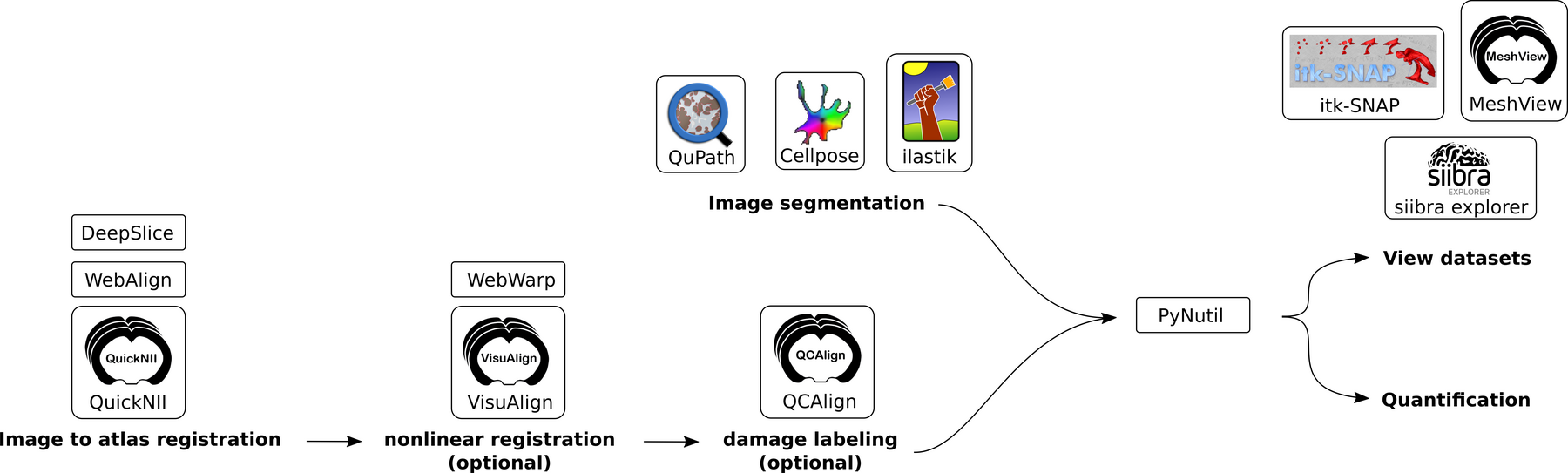
Overview#
PyNutil connects registration, segmentation and atlas data so that features in serial section images can be quantified across the whole brain. It takes outputs from tools such as QuickNII, VisuAlign, BrainGlobe registration and common image segmentation workflows, then produces atlas-based reports and spatial outputs.
PyNutil aims to replicate and expand the Quantifier feature of the Nutil software (RRID: SCR_017183) while making the workflow available from Python and from a desktop GUI.
Core workflows#
Count labelled objects or pixels in registered section images, then summarise them by atlas region.
Sample image intensity in atlas space for expression maps, tracer signal or other continuous measurements.
Transform pre-extracted detections into atlas coordinates and quantify their regional distribution.
Outputs#
PyNutil writes CSV reports for regional quantification, MeshView-compatible point clouds for spatial inspection, and NIfTI volumes for reconstructed 3D heatmaps. The same analysis patterns can be scripted with the Python API or run from the GUI.
Contents:
Highlights#
Use BrainGlobe atlases or custom atlas volumes in
.nrrdformat.Read registration data from QuickNII, VisuAlign, DeepSlice, or BrainGlobe registration outputs.
Quantify binary segmentations or intensity images against atlas regions.
Export point clouds for MeshView and interpolated NIfTI volumes for siibra explorer or ITK-SNAP.
Warning
PyNutil is still under development and the API is subject to change.
For more background on the QUINT workflow, see QUINT workflow documentation.